ABSTRACT
BACKGROUND
Keloid disease (KD) is a fibroproliferative disorder with unknown pathogenesis and
no effective treatment. The lack of an animal model and the limitations of 2D in vitro
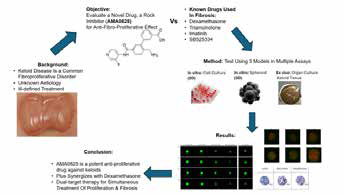
systems restrict evaluation of antifibrotic therapies. To overcome these challenges, we developed a novel 3D spheroid model of keloid fibroblasts (KFs) to assess the activity of the Rho-associated protein kinase (ROCK) inhibitor AMA0825 in comparison with dexamethasone (DEX).
METHODS
Normal fibroblasts (NFs) and KFs were cultured in ultra-low attachment (ULA) plates coated with agar or poly-2-hydroxyethyl methacrylate to promote spheroid formation at densities of 5k, 10k, and 20k cells. Morphology, size, and viability were evaluated over 7 days using microscopy and Calcein/propidium iodide staining. KF spheroids were treated with AMA0825 (0.5–50,000 nM) or DEX (80 μM), and proliferation was monitored for up to 7 days. Extracellular matrix (ECM) remodeling and collagen deposition were assessed by staining, immunocytochemistry, and quantitative analysis of fibrotic markers (Collagen I, α-SMA). Validation was further performed in keloid biopsy explants treated with AMA0825 (1 μM) or DEX (150 μM).
RESULTS
Both KF and NF formed viable spheroids within 3 days, with KF spheroids
consistently larger than NF. Viability analysis confirmed high numbers of live cells,
though higher cell density (20k) increased necrosis due to nutrient limitation.
AMA0825 demonstrated a clear dose-dependent inhibition of KF proliferation,
with optimal effects at 96 hours. Significant inhibition was observed at ≥50 nM,
with up to 92.6% reduction at 50,000 nM, surpassing the antiproliferative effect
of DEX at 80 μM. At nanomolar concentrations, AMA0825 achieved comparable
or greater proliferation suppression than DEX. ECM analysis revealed that DEX
significantly reduced collagen levels, while AMA0825 showed limited collagen
reduction at antiproliferative doses. However, at higher concentrations (≥1000 nM),
AMA0825 decreased Collagen I and α-SMA expression, indicating antifibrotic
potential.
CONCLUSIONS
This study establishes a robust 3D KF spheroid model as a reliable platform for drug testing in KD. AMA0825 demonstrated potent, dose-dependent antiproliferative
activity and reduced fibrotic marker expression at higher concentrations, outperforming DEX in proliferation assays. These findings highlight ROCK inhibition as a promising strategy for KD, with AMA0825 showing potential for further preclinical development, particularly in combination with corticosteroids.