
BACKGROUND:
Keloid is a kind of benign skin fibroproliferative disease with a high recurrence risk. At present, comprehensive therapy is commonly used in treatment, but the high recurrence rate is still an urgent problem to solve. Moreover, the existing comprehensive treatment methods also have various problems, such as high cost, complex process, multiple side effects and so on.
METHODS:
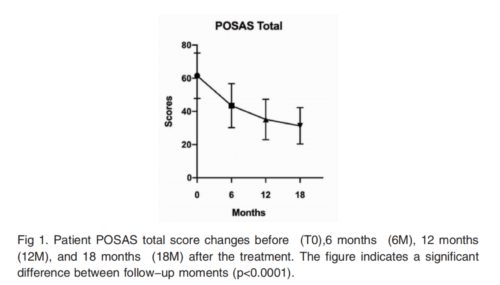
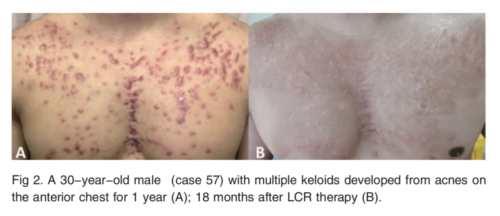
99 patients with keloids who received ablative fractional carbon dioxide laser combined with radiotherapy (LCR) from February 2018 to November 2019 were studied and analyzed retrospectively. The LCR treatment was composed of one session of ablative fractional CO2 laser and two sessions of electron beam irradiation. The patient received ablative fractional CO2 laser first with an energy range of 360-1008mj. Radiotherapy was performed with 6MeV electron beam secondly. The first pass was completed within 24 hours after laser therapy, and the second pass was completed on the 7th day after that. 9Gy energy was used for radiotherapy. The efficacy was evaluated by Patient and Observer Scar Assessment Scale (POSAS) before treatment and 6, 12 and 18 months after treatment.
At the same time, the recurrence, side effects and satisfaction with the results were evaluated by online questionnaire.
RESULTS:
The total POSAS scores at 18 months follow-up was significantly lower than that before treatment (31.3 $ 11.0 vs 61.5 $ 13.7, P < 0.0001). During the follow-up period, 12.1% of the patients had recurrence, of which 11.1% had partial recurrence and 1.0% had complete recurrence. The overall satisfaction rate was 97.0%. No serious adverse reactions were observed during follow-up.
Table1. Patient and Observer Scar Assessment Scale before and 18 months after
the therapy
| Metric | Before Treatment | 18 Months After Treatment | P-value |
| Total Score | $61.5 \pm 13.7$ | $31.3 \pm 11.0$ | $<0.0001$ |
| Patient Score | $38.6 \pm 10.8$ | $19.5 \pm 9.8$ | $<0.0001$ |
| Pain | $3.4 \pm 2.6$ | $1.6 \pm 1.2$ | $<0.0001$ |
| Pruritus | $4.6 \pm 2.7$ | $2.2 \pm 1.6$ | $<0.0001$ |
| Color | $8.2 \pm 2.2$ | $4.6 \pm 2.7$ | $<0.0001$ |
| Stiffness | $7.5 \pm 2.4$ | $3.9 \pm 2.5$ | $<0.0001$ |
| Thickness | $7.7 \pm 2.6$ | $3.7 \pm 2.6$ | $<0.0001$ |
| Irregularity | $7.3 \pm 2.5$ | $3.6 \pm 2.3$ | $<0.0001$ |
| Observer Score | $23.0 \pm 6.0$ | $11.7 \pm 3.0$ | $<0.0001$ |
| Vascularity | $3.6 \pm 1.6$ | $1.8 \pm 0.7$ | $<0.0001$ |
| Pigmentation | $6.2 \pm 1.8$ | $2.5 \pm 0.7$ | $<0.0001$ |
| Thickness | $4.1 \pm 1.7$ | $2.2 \pm 0.8$ | $<0.0001$ |
| Tension | $4.5 \pm 1.7$ | $2.5 \pm 0.8$ | $<0.0001$ |
| Elasticity | $4.5 \pm 1.4$ | $2.5 \pm 0.7$ | $<0.0001$ |
C O N C L U S I O N :
LCR is a new comprehensive treatment for keloid which has not been reported by other scholars yet. The research results show that it has the benefit of good curative effect, low recurrence rate and high safety. This paper provides a theoretical basis for widely developing this method clinically. This abstract reports on original research. There search is not a clinical trial and was not funded by any government agency, pharmaceutical or biotechnology companies or other foundations.