
Background
Accurate keloid assessment is crucial for effective treatment planning. The Vancouver Scar Scale (VSS) is widely used but relies on subjective observation, leading to variability in scoring. Laser Speckle Contrast Imaging (LSCI) has emerged as a promising technique for objective assessment of keloid vascularity by quantifying blood perfusion. This study investigates the correlation between LSCI-derived perfusion metrics and VSS scores to evaluate their clinical utility in keloid assessment and treatment monitoring.
Methods
A retrospective study was conducted on 99 patients with 176 keloids. Blood perfusion ratios ($PU_{keloid} / PU_{control}$) derived from LSCI were compared with pre- and post-treatment VSS scores. Correlation analysis and linear regression were applied to determine the relationship between perfusion metrics and VSS changes. Clinical cases were analyzed to validate the effectiveness of the perfusion ratio in guiding treatment.
Results
$PU_{keloid} / PU_{control}$ demonstrated a significant correlation with total VSS scores (Spearman's $\rho = 0.308, p < 0.001$) and its subcomponents, particularly vascularity (Spearman's $\rho = 0.424, p < 0.001$). The strongest associations were observed between the perfusion ratio and vascularity and pigmentation scores, emphasizing the role of perfusion in keloid severity.
Linear regression analysis showed a strong association between changes in $PU_{keloid} / PU_{control}$ and improvements in VSS scores ($R^2 = 0.539, p < 0.01$), indicating that perfusion changes can reliably reflect therapeutic outcomes.
Further subgroup analysis revealed that the ratio ($PU_{keloid} / PU_{control}$) was superior to absolute $PU_{keloid}$ values in evaluating both keloid lesions and post-surgical linear wounds. Patients who demonstrated a greater reduction in the ratio post-treatment also exhibited more significant clinical improvement.
Key Statistical Summary
| Metric | Correlation with Total VSS | Correlation with Vascularity | Regression (R2) |
| $PU_{keloid} / PU_{control}$ | $0.308$ ($p < 0.001$) | $0.424$ ($p < 0.001$) | $0.539$ |
substantial improvements in their VSS scores. Additionally, clinical cases demonstrated that high -perfusion areas identified via LSCI often corresponded with regions of persistent inflammation or poor therapeutic response, highlighting the potential role of targeted intervention strategies.
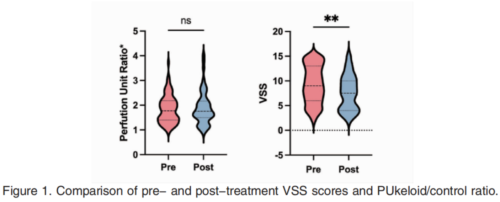
Violin plots demonstrating significant improvements in VSS scores post-treatment, while no significant changes were observed in the PUkeloid/control ratio. *: The ratio of blood perfusion in the keloid region and adjacent normal skin.
Among the 44 patients (56 keloids) who underwent post-treatment follow-up, the most common therapeutic approaches included pulsed dye laser (PDL) combined with betamethasone and 5-fluorouracil (35.17%), and surgery with radiotherapy (19.64%). While overall VSS scores significantly improved after treatment (median: 9 [6 - 13] to 7.5[4 - 10], p = 0.005), no significant change was observed in absolute PUkeloid/control values at the group level (p = 0.942). However, a strong correlation was noted between changes in perfusion ratio (AR) and changes in VSS scores (AVSS), suggesting that individualized perfusion changes may better reflect treatment outcomes.
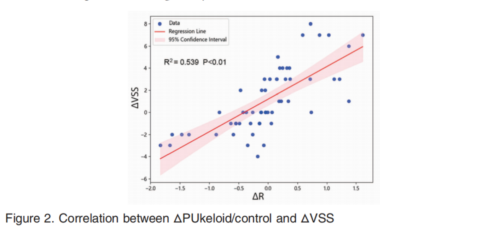
A scatterplot showing the linear regression analysis of the correlation between changes in $PU_{keloid} / PU_{control}$ ratio and VSS scores ($\Delta R$ and $\Delta VSS$), with an $R^2$ value of 0.539.
Definitions:
$\Delta VSS$: Change in Vancouver Scar Scale.
$\Delta R$: Change in perfusion ratio ($PU_{keloid} / PU_{control}$).
Clinical cases further supported these findings. One patient exhibited a marked decrease in the $PU$ ratio following combination therapy, which corresponded with improved scar pliability and pigmentation. Conversely, another patient with persistently high $PU_{keloid} / PU_{control}$ despite treatment demonstrated poor clinical response, reinforcing the importance of vascular assessment in treatment planning.
Regression Analysis Summary
Coefficient of Determination ($R^2$): 0.539
Significance: $p < 0.01$
Clinical Insight: Perfusion ratios are more predictive of outcome than absolute perfusion values.
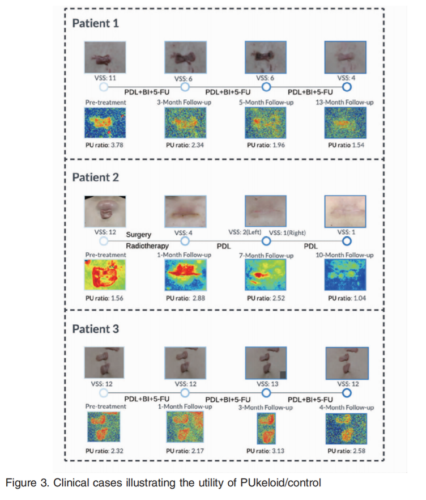
Photographs and LSCI perfusion images from three patients demonstrating the effectiveness of $PU_{keloid} / PU_{control}$ in monitoring keloid treatment outcomes.
Abbreviations:
VSS: Vancouver Scar Scale
PU ratio: Blood perfusion ratio ($PU_{keloid} / PU_{control}$)
PDL: Pulsed Dye Laser
BI: Betamethasone injection
5-FU: 5-Fluorouracil
Conclusion
LSCI-derived $PU_{keloid} / PU_{control}$ provides an objective, non-invasive method for assessing keloid vascularity. This metric complements traditional tools like VSS, enhancing scar evaluation and treatment planning. Further studies are needed to optimize its clinical applications.
| Category | Details |
| Original Research | YES |
| Clinical Trials | NO |
| Funding Source | National High Level Hospital Clinical Research Funding (Grant nos. 2022-PUMCH-B-042, 2022-PUMCH-B-041, 2022-PUMCH-A-210, 2022-PUMCH-C-025) |
| IRB/Ethics Approval | Ethics Review Committee of Peking Union Medical College Hospital (I-24PJ0121) |
| Disclosure | None |