BACKGROUND
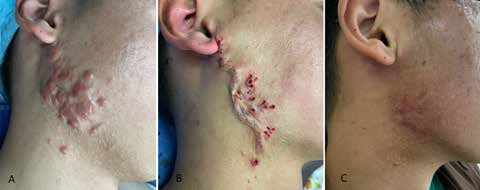
Mandibular keloids significantly impair the appearance and psychological well-being of patients, and their treatment remains a challenging issue. This study aimed to evaluate the clinical efficacy of mini-punch surgery combined with radiotherapy (RT) for treating mandibular keloids.
METHODS
A total of 16 patients with mandibular keloids were included in this study. Initially,
they underwent mini-punch surgery, followed by RT within 24 hours post-surgery.
The RT regimen consisted of four fractions, administered every other day at a dose
of 5 Gy per fraction. The Vancouver Scar Scale (VSS), Patient and Observer Scar
Assessment Scale (POSAS) 2.1 Patient scale, and Physician’s Subjective Assessment
(PSA) were assessed pre-operatively and at 1-year follow-up post-treatment.
RESULTS
At 1-year follow-up, 68.75% (11/16) of patients reported a self-assessment
improvement of over 75% compared to baseline. The mean pre-treatment VSS score
was 9.31 ± 0.45, which decreased to 3.81 ± 0.67 post-treatment. The postoperative
VSS score at 1-year follow-up was significantly lower than the pre-treatment score (p
< 0.001). Additionally, the mean pre-treatment POSAS 2.1 Patient scale score was
18.06 ± 0.99, decreasing to 7.0 ± 1.47 post-treatment (p < 0.001).
CONCLUSION
The micro-trephine punch technique, either alone or in combination with surgical
excision, represents an effective treatment option for scattered and extensive
mandibular keloids.