BACKGROUND
Keloids are scars resulting from an exacerbated inflammatory response that leads to abnormal fibrous skin healing. Beyond visible disfigurement, they may cause pruritus, pain, contractures, and motor dysfunction, with significant impact on self-esteem and mental health. These features highlight the importance of incorporating patient- reported outcomes into therapeutic assessment. This study evaluates the impact of keloids on physical, emotional, and social domains, as well as the risk of depressive symptoms. The A.S.A.P. protocol (Assessment, Softening, Application, and Protection) is a structured, non- surgical algorithm developed in Brazil to address high recurrence rates associated with isolated treatments such as surgery, corticosteroids, cryotherapy, laser, and radiotherapy. It integrates lesion assessment, tissue softening, combined use of technologies and antifibrotic agents, and management of pigmentary alterations. The protocol has been refined to include modalities such as microneedling, verapamil, botulinum toxin, and picosecond laser. This sequential approach aims to promote progressive clinical improvement while reducing recurrence.
METHODS
This is a prospective, longitudinal study that analyzed adult patients seen between 2025 and 2026 at the Mário Penna and Luxemburgo hospitals, as well as in a private practice setting. Follow-up was conducted at two time points: at baseline and at the end of treatment (after approximately 6 months). A total of 28 patients who completed the full evaluation protocol were included. Data collection used two standardized instruments: the QUALIFIBRO, a questionnaire that assesses quality of
life in patients with keloids or fibrotic scars across the Psychological (emotional/social impact) and Physical (pain/pruritus/movement) domains; and the Beck Depression Inventory (BDI), which screens for depressive symptoms with classification into Minimal (0–11), Mild (12–19), Moderate (20–35), and Severe (36–63) categories, according to Cunha (2001). Paired pre- vs. post- treatment comparisons were performed using the Wilcoxon test, and comparisons between sexes using the Mann-Whitney test (p<0.05). This design allowed quantification of intra- individual changes across physical, psychological, and mood- related outcomes.
RESULTS
At the beginning of treatment, 28.6% of patients had a positive screen for clinically relevant depressive symptoms by the BDI (score ≥ 12), a prevalence 2.6 times higher
than the average of the general Brazilian population. After completion of treatment, all outcomes showed statistically significant improvement. The physical domain showed the greatest statistically significant reduction (p=0.0004). Item-level analysis of the QUALIFIBRO revealed that the most significant reductions were observed in pruritus items: frequency of itching (Q4; p=0.0002), inability to resist scratching (Q8; p=0.0005), and difficulty tolerating it (Q6; p=0.013), as well as reduced climatic interference with the lesion (Q1; p=0.019). In the psychological domain, statistically significant reductions were observed in concealment of the condition from close individuals (Q7; p=0.031) and self-confidence (Q13; p=0.030), suggesting an impact on social stigma. At the individual level, 71.4% of patients improved in the physical domain and 64.3% in mood; however, 14.3% worsened in the physical domain and 32.1% in the psychological domain, highlighting the need
for individualized clinical monitoring. Category migration was also observed: 62.5% of patients with a positive screen at baseline (Mild or Moderate by BDI) migrated to the Minimal category by the end of the study, without formal psychiatric or psychotherapeutic intervention; conversely, one patient progressed from Minimal to Mild, underscoring the relevance of longitudinal follow-up. In the BDI, improvement was concentrated in self-criticism and body perception (B8; p=0.004), concern with physical symptoms (B20; p=0.047), indecisiveness (B13; p=0.021), perception of worthlessness and appearance (B14; p=0.020), and social withdrawal (B12; p=0.034), with no significance in items of sadness or hopelessness, suggesting that mood improvement may be related to physical and social symptom relief rather than by a direct antidepressant effect. There was no statistically significant difference between sexes (p>0.20), although men showed a numerically greater median improvement in both the physical (Δ −2.40 vs −1.40) and psychological (Δ −1.89 vs −0.89) domains.
CONCLUSION
A positive screen for depressive symptoms was identified in nearly 1 in 3 patients at the initial consultation, a prevalence 2.6 times higher than that of the general Brazilian population.
These findings suggest that structured dermatological treatment may be associated with improvement in quality of life and mood, in addition to cutaneous outcomes. Remission of positive screening in 62.5% of patients, concentrated in items of body perception, pruritus, and social stigma, is consistent with the hypothesis that mood improvement may be mediated by relief of physical and visual symptoms, rather than by a direct antidepressant effect. The absence of mood improvement in items of sadness or hopelessness further supports this hypothesis. These findings are consistent with a biopsychosocial impact of structured keloid treatment and
suggest two practical considerations: routine screening for depressive symptoms using the BDI as part of the initial dermatological evaluation; and institutional recognition that keloid treatment may offer mental health-related benefits: a consideration relevant to coverage policies in public and private health systems and to patient engagement during prolonged treatment.
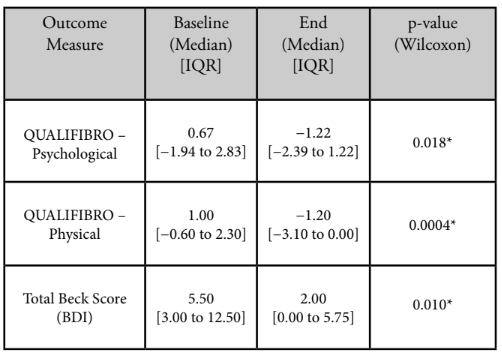
Table 1. Pre- and post-treatment outcomes (n = 28). *p<0.05. Note: In the QUALIFIBRO instrument, negative values indicate improvement in quality of life. In the BDI, lower values indicate reduction of depressive symptoms.