Guinevere I. Perry, PhD
ABSTRACT
Keloid scars are a common result of abnormal wound heal-ing and can cause pain, discomfort, and cosmetic concerns, especially among individuals of Black, Hispanic, or Asian descent. Conventional treatments are often invasive, costly, and only partially effective. This case report describes a 45-year-old African American female who developed a promi-nent keloid scar following emergency hysterectomy for post-surgical sepsis. The patient began a non-invasive regi-men of oral Vitamin D3 and K2 supplementation, along with topical application of isopropanol and salicylic acid. Treat-ment was applied twice daily for six weeks, then once daily, and eventually every other day. After four months, the pa-tient experienced resolution of pain and itching, reduced keloid size and elevation, improved skin texture, and no new scar formation. This outcome suggests that combining vitamin supplementation with topical antiseptic care may offer a promising, cost-effective alternative for keloid man-agement. To our knowledge this is the first case to use me-thyl salicylate to treat KD. Further research is warranted to validate these findings.
Scar tissue forms as part of the body’s natural healing process following skin injury due to surgery, trauma, or infection. This process involves cellular mitosis and collagen deposition. However, excessive collagen production or abnormal healing can result in raised scars, such as hypertrophic scars or keloids. Keloids are typically more than 4 mm above the skin surface and may continue to grow beyond the original wound margins. These scars can cause discomfort, pain, and restricted movement, especially when located near joints or areas subject to friction.
Keloid formation is more prevalent among individuals of Black, Hispanic, or Asian descent 5,12. Treatment options—such as corticosteroid injections, silicone sheets, or surgical excision—are often expensive, invasive, and not always effective 7, 8. These treatments generally reduce the appearance of scar tissue but do not fully restore normal skin architecture 9-11.
Only a few studies have conducted a preliminary investigation into the possible benefits of using methyl salicylate as a mild anti-inflammatory treatment for autoimmune disorders14, 16 However, most of these studies have focused on the reduction in the gene expression of inflammatory producing interleukins and not clinical outcome of a treatment.
Brief History
The 45-year-old patient described in this case report was African American ancestry, born female, and previously diagnosed with Hashimoto’s thyroiditis by her endocrinologist and post-surgical hypertrophic scarring by her surgical gynecologist. The autoimmune disorder was diagnosed based on elevated Anti-Thyroid Peroxidase (TPOAb) count. The KD was diagnosed by a visual and physical examination. The prior diagnoses occurred in February 2024 and Dec 2023 respectively. This case report is based on the patient medical record, images, and patient disclosures, permission was granted for the disclosure of personal medical history and the use of images in this report.
In April 2023, the patient underwent a fibroid embolization procedure intended to remove uterine fibroids and preserve future fertility. One fibroid measured approximately the size of a small grapefruit. Post-procedure, the patient developed extensive necrotic tissue in the abdominal cavity and subsequently became septic, necessitating preparation for an emergency hysterectomy.
In September 2023, the patient underwent an emergency full hysterectomy performed by an oncology gynecologist. Although the procedure was not cancer-related, it resulted in a large surgical incision extending from the pelvic region to the mid-torso. The wound healing process was atypical, leading to the development of a prominent keloid scar along the incision line, accompanied by several smaller hypertrophic scars at suture removal sites.
Over the following 12 months, the keloid expanded in size and caused persistent itching and intermittent pain, particularly when clothing rubbed against the area. The patient was advised that only a dermatologist could reduce the scar tissue using corticosteroid injections.
METRICS
Guinevere Perry, PhD
(Microbiology)
ATA College Nursing Department
1685 Medical Ln #200, Fort Myers, FL 33907
Email: gperry@ata.edu
Beverly Walker, MD
(Pediatrician)
Phoebe Putney Hospital
311 Second Avenue
Albany, GA 31699
Board Certified: American Board of Pediatrics
Medical School: Meharry Medical School Medical School
Internship: Hurley Medical School Residency
Call: 229-883-0537
Email: beverlymwalker@gmail.com
Keywords
Keloid, Anti-Inflammatory, Hypertrophic Scar
Abbreviations
KD- Keloid Scar
Running Title
Non-Invasive Management of Keloid Scars: Methyl Salicylate Topical Application and Vitamin D3 Supplementation.
Word Count
10,835; Abstract: 1568 words
Treatment Regimen
In February 2025, the patient initiated a self-directed, non-invasive treatment protocol consisting of oral supplementation and topical care:
Oral Composition
- Vitamin D3: 25 mcg daily
- Vitamin K2: 100 mg daily
Topical Composition
- Antiseptic Solution: Containing isopropanol and salicylic acid
- Application Schedule:
- Weeks 1–6: Applied twice daily
- Weeks 7–16: Reduced to once daily after pain subsided
- After 4 months: Applied every other day to prevent skin dryness
Clinical Outcome
After four months of consistent treatment, the patient reported significant improvement:
- Pain and itching: Resolved within six weeks
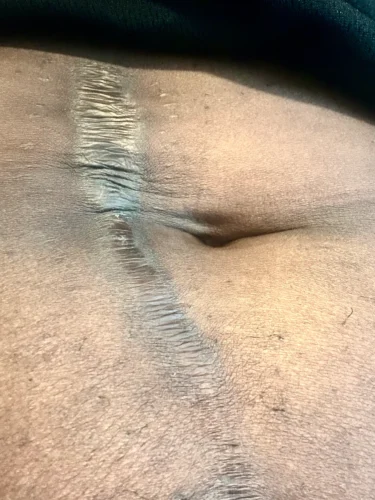
- Scar appearance: Noticeable reduction in keloid size and elevation
- Skin texture: Improved elasticity and reduced discoloration
- No new scar formation was observed during or after the treatment period
Figure 1: Pre-treatment image showing large, raised keloid scar across the lower abdomen
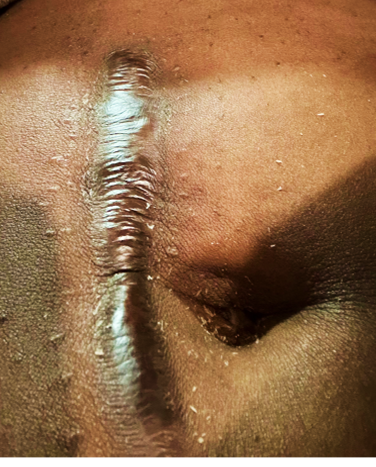
Figure 2: Post-treatment image showing reduced scar tissue, now largely below the skin surface with improved texture (4 months of treatment)
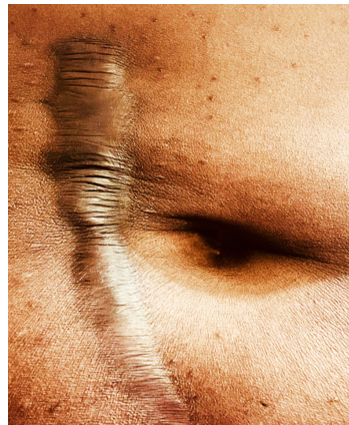
Figure 3: Post-treatment image increased shrinkage of scar tissue (9 months of treatment)
Discussion
This case demonstrates a potential non-invasive approach to managing keloid scars using a combination of vitamin supplementation and topical antiseptic treatment. Emerging literature suggests that Vitamin D3 may inhibit Cutibacterium and fungal skin pathogens, which are commonly found on human skin1,2. While no direct link has been established between Cutibacterium and keloid formation, some studies suggest a possible role in hypertrophic scarring due to the bacteria’s ability to release extracellular vesicles (EVs) that interact with skin tissue3, 6,15.
Salicylic acid, a known keratolytic agent, may contribute to scar improvement by reducing microbial load and enhancing skin turnover. The synergistic effect of Vitamin D3, Vitamin K2, and salicylic acid may offer a promising avenue for further research into non-invasive scar management4.
Conclusion
Following an eight-month regimen of oral Vitamin D3 and K2 supplementation combined with topical antiseptic application containing salicylic acid, the patient experienced significant reduction in keloid size, pain, and itching. This case suggests a potential alternative approach to managing keloid scars, particularly for patients seeking non-invasive and cost-effective options.
Clinical Review of Case
This subsection was completed by Beverly Walker, MD, a pediatrician with 50 years of clinical experience. Dr. Walker has personally identified and diagnosed keloid and/or hypertrophic conditions in pediatric patients.
The patient’s hypertrophic scar demonstrated partial healing following treatment, though complete resolution was not achieved. This suggests that while the intervention is effective in improving scar characteristics, it may not fully eliminate hypertrophic tissue in all cases. Given that pediatric patients with hypertrophic scars often present with increased rigidity and are more challenging to manage, extending this treatment approach to adolescent populations could be advantageous13. Adolescents are at higher risk of postoperative scarring due to metabolic changes associated with puberty and growth, and their scars tend to enlarge as they age. Utilizing methyl salicylate acid in this demographic may enhance therapeutic outcomes, potentially leading to complete scar resolution due to their heightened responsiveness to treatment.
References
- Alhetheli, G., Elneam, A. I. A., Alsenaid, A., & Al-Dhubaibi, M. (2020). Vitamin D levels in patients with and without acne and its relation to acne severity: a case-control study. Clinical, cosmetic and investigational dermatology, 759-765.
- Chen, Q., Hou, S., Wu, X. Y., Bu, W. B., Zhou, B. R., & Chen, X. D. (2025). Microbial analyses of infectious keloids on the anterior chest—a case–control study. Archives of Dermatological Research, 317(1), 199.
- Cheung, C. T., Lancien, U., Corvec, S., Mengeaud, V., Mias, C., Véziers, J., ... & Dréno, B. (2024). Pro‐inflammatory activity of Cutibacterium acnes phylotype IA1 and extracellular vesicles: An in vitro study. Experimental Dermatology, 33(8), e15150.
- Essam, R., Nasr, M., Khater, M. W., Fayez, B., & Anis, N. (2024). Anti-microbial impact of non-antibiotic agents; salicylic acid, N-acetylcysteine, and isotretinoin against Cutibacterium acnes in patients with acne vulgaris. Archives of Dermatological Research, 317(1), 155.
- Fang, Q. Q., Wang, X. F., Zhao, W. Y., Chen, C. Y., Zhang, M. X., Shi, B. H., & Tan, W. Q. (2018). The source of ACE during scar formation is from both bone marrow and skin tissue. The FASEB Journal, 32(9), 5199-5208.
- Felix Montero-Julian, PhD (2021) Cutibacterium Acnes Gram Positive Bacteria Causing Infection, bioMérieux industrial microbiology
- Gianatasio, C., Abrouk, M., & Waibel, J. S. (2021). Treatment approaches for treating hypertrophic scars and keloids. Dermatological Reviews, 2(1), 11-22.
- Heppt, M. V., Breuninger, H., Reinholz, M., Feller-Heppt, G., Ruzicka, T., & Gauglitz, G. (2015). Current strategies in the treatment of scars and keloids. Facial Plastic Surgery, 31(04), 386-395.
- Mustoe, T. A. (2004). Scars and keloids. Bmj, 328(7452), 1329-1330.
- Swenson, A., Paulus, J. K., Jung, Y., Weiss, S., Berman, B., Peeva, E., ... & Jagun, O. (2024). Natural history of keloids: a sociodemographic analysis using structured and unstructured data. Dermatology and Therapy, 14(1), 131-149.
- Tuffley, M. (2019). U.S. Patent No. 10,300,028. Washington, DC: U.S. Patent and Trademark Office.
- van den Broek, L. J., Limandjaja, G. C., Niessen, F. B., & Gibbs, S. (2014). Human hypertrophic and keloid scar models: principles, limitations and future challenges from a tissue engineering perspective. Experimental dermatology, 23(6), 382-386.
- van de Kar, A. L., van Riessen, F., Koolbergen, D. R., & van der Horst, C. M. (2020). Influence of age on scar tissue: a retrospective study on the differences in scar tissue development between children and adults. Journal of Plastic, Reconstructive & Aesthetic Surgery, 73(7), 1357-1404.
- Vidal, M., & Roldán, T. (2024). Penetration capacity and local anti-inflammatory effect of a methyl salicylate gel with turpentine essence, camphor, and menthol for the symptomatic local treatment of muscular and joint pains. Farmaceuticos Comunitarios, 16(3), 5-11.
- Yu, T., Chen, J., Wu, S., Jiang, M., Han, L., & Ma, Y. (2024). Potential functionality of Cutibacterium acnes extracellular vesicles in atopic dermatitis and acne vulgaris: A comparative proteomic analysis. PROTEOMICS–Clinical Applications, 18(5), 2300106.
- Zhang, X., Sun, J., Xin, W., Li, Y., Ni, L., Ma, X., ... & Du, G. (2015). Anti-inflammation effect of methyl salicylate 2-O-β-D-lactoside on adjuvant induced-arthritis rats and lipopolysaccharide (LPS)-treated murine macrophages RAW264. 7 cells. International immunopharmacology, 25(1), 88-95.